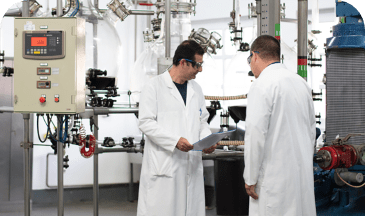
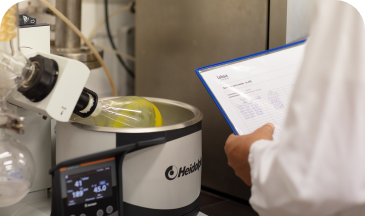
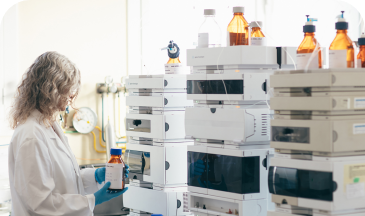
LEBSA es una empresa fundada en 1951 y dedicada a la investigación, desarrollo y síntesis de productos químicos orgánicos. LEBSA tiene como objetivo la síntesis de nuevas moléculas con aplicaciones terapéuticas y el estudio de nuevos procesos de síntesis para moléculas ya conocidas.
LEBSA aplica a todos sus productos un riguroso proceso de control (G.M.P.); por su pureza y perfecta correspondencia con sus especificaciones, sus fabricados son muy bien aceptados en el mercado interior y exportados a todo el mundo.
LEBSA está equipada con reactores polivalentes de vidrio, acero inoxidable y esmaltados, de tamaños comprendidos entre 10 y 1.600 l. y dotados de todos los servicios necesarios. LEBSA puede ofrecer productos en muy diversas cantidades, desde pequeños lotes de ensayo, a algunas toneladas por año.
LEBSA está especializada en la fabricación, per encargo, de Fine Chemicals para la Indústria Química Farmacéutica.
Description.................. White crytalline powder
Melting Point................ 124 - 128ºC
IR Spectrum.................. Similar to standard
Solubility................... To pass test
Appearance of solution:
Optical rotation............. -0.10º to +0.10º
Impurity A TLC............... Max.: 0.1%
Related substances HPLC:
2-Propanol................... Max.: 5000 ppm
Chlorides.................... Max.: 200 ppm
Heavy Metals................. Not more than 10 ppm
Loss on drying............... Not more than 0.5%
Sulphated ash................ Not more than 0.10%
Assay........................ 99.0 - 101.0%
Description.................. Crystalline powder
I.R. Spectrum................ Similar to standard
Chlorides.................... Passes Test
Melting point................ 150 - 154 ºC
Opalescence.................. Passes Test
Colour....................... Passes Test
pH........................... 2.0 - 3.0
HPLC
Ash.......................... Not more than 0.1%
Heavy metals................. Not more than 20 ppm
Loss on drying............... Not more than 1%
Residual ethanol............. Max: 1000 ppm
Description.................. White crystalline powder
Identification
Appearance of solution....... Clear and colourless
Related substances HPLC
2-Propanol................... Not more than 5000 ppm
Chlorides.................... Not more than 35 ppm
Sulphates.................... Not more than 250 ppm
Heavy Metals................. Not more than 20 ppm
Water........................ Not more than 2.0%
Assay........................ 98.0 - 101.0 %
Description........................... White powder
IR Spectrum........................... Similar to standard
Colour and opalescence of solution 10% To pass test
Loss on drying........................ Not more than 1.0%
pH 10%................................ 9 - 10
Melting point......................... 151 - 155ºC
Related substances (TLC).............. Not more than 0.5%
Heavy metals.......................... Not more than 20 ppm
Residue on ignition................... Not more than 0.10%
Assay................................. 98 - 102%
Description......................... White or yellowish-white powder
Tests
Assay............................... 95.0 - 101.0%
Description................... White powder
IR Spectrum................... Similar to standard
Identification B.............. To pass test
pH............................ 5.0 - 6.0
Loss on drying 105 ºC......... Not more than 2.0%
Sulphated ash................. Not more than 0.1%
Assay......................... 99.0 - 101.0%
Residual acetone.............. Not more than 0.5%
Appearance.................... White powder
Melting Point................. 237.0 - 242.0ºC
Colour........................ To pass test
Opalescence................... To pass test
Solubility.................... To pass test
pH............................ 5.0 - 7.0
Loss on drying................ Not more than 1.0%
HPLC Individual impurities.... Not more than 0.5% each
Sulphuric ash................. Not more than 0.1%
Ammonium isetionate........... Not more than 1.0%
Residual acetone.............. Not more than 2500 ppm
Assay......................... 98.0 - 102.0%
Appearance................... White powder
Opalescence.................. To pass test
Colour....................... To pass test
TLC.......................... To pass test
Chlorides.................... Not more than 100 ppm
Iron......................... Not more than 10 ppm
Heavy metals................. Not more than 10 ppm
Sulphated ash................ Not more than 0.1%
Assay........................ 98.5 to 101%
Appearance of solution: Clear Absorbance 450 nm less than 0.030
pH........................... 4.0-6.0
Impurity C (TLC)............. Not more than 0.1%
Assay........................ 98.5 - 101.0%
Description .................. Yellow powder
Acetate....................... Not more than 1.0%
Methanesulphonic acid......... Mot more than 0.3%
HPLC Related substances:
Heavy metals ................. Not more than 20 ppm
Loss on drying ............... Not more than 2.0%
Assay ........................ 98.0 - 102.0%
Description................... White or almost white powder
Loss no drying................ Not more than 1.0%
Ash........................... Not more than 0.1%
Purity HPLC................... Not less than 99.0%
IR spectrum................... Similar to standard
Melting point................. 202 - 206ºC
Purity HPLC................... Not less than 98.0%
Melting point................. 191-195ºC
Cololur....................... Not more than Bq.
Opalescence................... Not more than Ref. I.
PH............................ 3.5 - 5.5
Assay......................... Not less than 98.5%
Description................... White to pale yellow powder
2-propanol.................... Not more than 0.5%
water......................... Not more than 0.2%
Assay......................... 97.5 - 102.0%
purity HPLC................... Not less than 99.0%
Description................... Yellow powder
Solubility.................... Passes test
I. R. spectrum................ Similar to standard
Melting point................. 133.0 - 137.0ºC%
Ash........................... Not more than 0.10%
Solubility.................... Soluble in water (1:1000)
Melting point................. About 281ºC
Loss on drying................ Not more than 2.0%
Heavy Metals.................. Not more than 20 ppm
Related substances............ Not more than 0.5%
pH............................ 4.0 - 6.0
p-Chloroaniline............... less than 200 ppm
Assay......................... Min. 97.5%
Ash .......................... Not more than 0.1%
IQS http://www.iqs.es
Universitat de Barcelona http://www.ub.edu